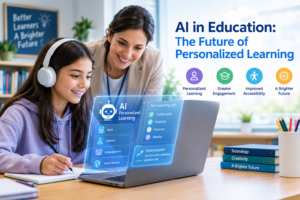
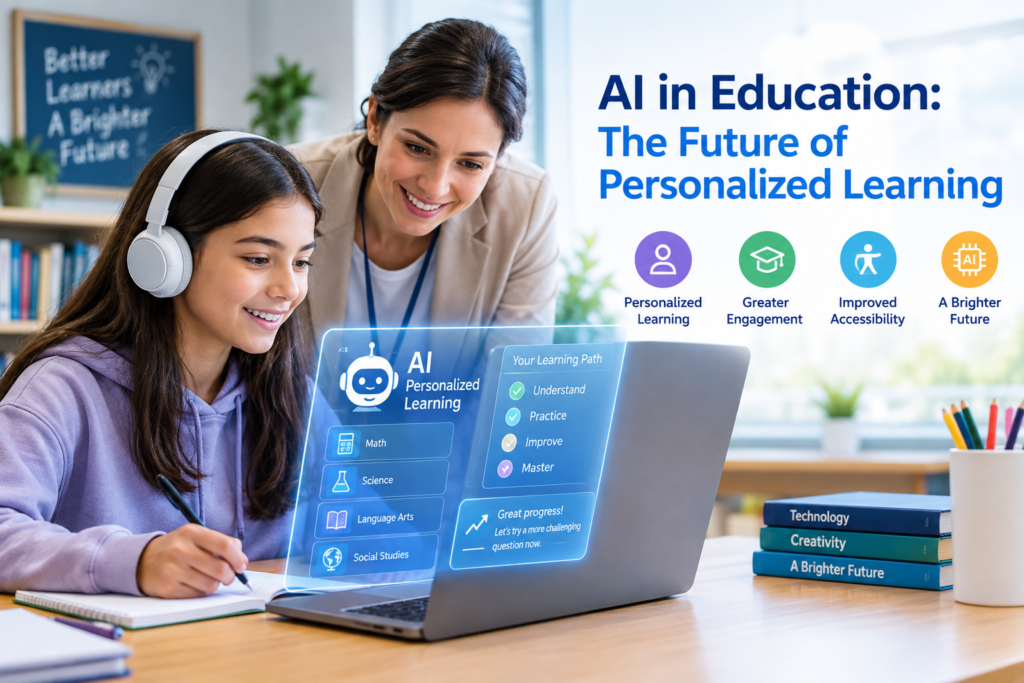
Imagine a class where each student has their own tutor, one who knows exactly what they struggle with, what engagement captures their interest, as well as the pacing of their learning. This is not a far-off future; this is what AI in education is beginning to enable. From K-12 to higher education, adaptive platforms, intelligent tutoring systems, and AI-enabled data analytics are changing how students learn and how teachers teach. This article will discuss how AI in education can be used for personalized learning, advantages, challenges, and what it means for educators, learners, and designers.
Traditional vs AI in Education: A Comparison of Learning Models
To appreciate the impact of AI in education, let’s compare how traditional classrooms differ from AI-powered personalized learning models.
Traditional Learning
- Teaching pace and content that suits everyone.
- Feedback usually comes after tests or assignments.
- Not much flexibility for different learning needs.
AI-Driven Personalized Learning
- Adjusts to each learner’s speed, performance, and choices.
- Provides instant feedback for quicker improvement.
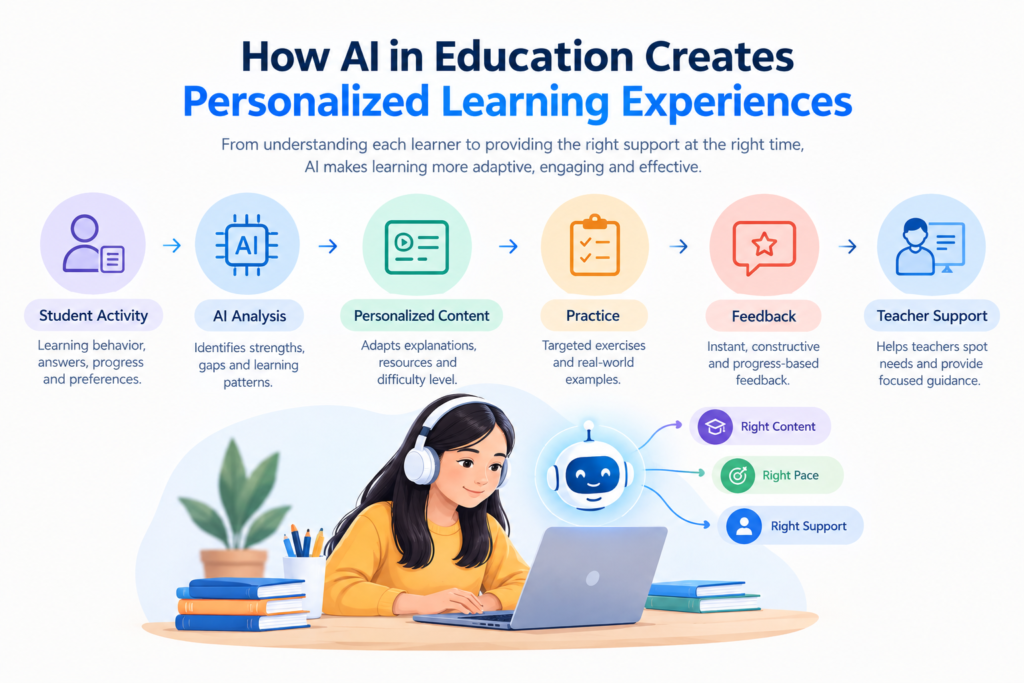
- Uses data analysis to find strengths and weaknesses.
The most recent PISA 2025 results indicate that the connection between the use of AI and student outcomes is multifaceted. There was a smaller average science score difference between students who used AI for specific tasks of their schoolwork, like summarizing or composing, and those who did not, and a different pattern for those who used general-purpose AI. The report highlights that AI is not meant to take the place of the thought process, but rather a tool to aid students in their “effortful learning.
Key Insights: How AI in Education Is Personalizing Learning
Adaptive Learning Paths with AI in Education
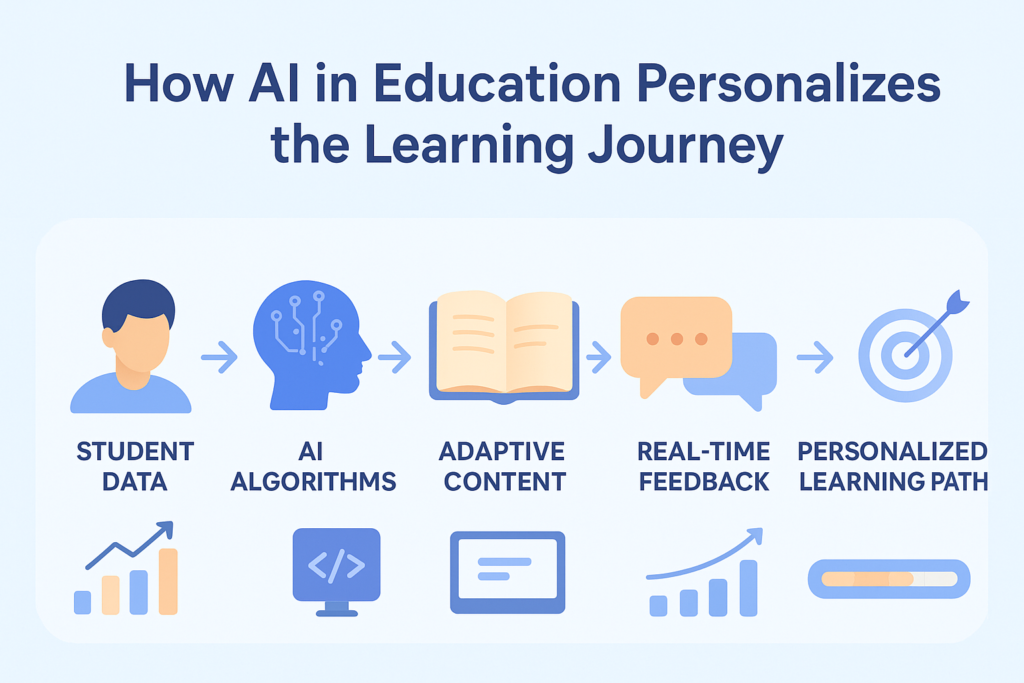
- AI in education-powered algorithms monitor student performance in real time, tracking learning pace, quiz scores, interests, and challenges.
- When a student struggles with a concept, the system automatically adjusts by offering alternative explanations, switching from text to visuals, or pacing content differently.
- Research shows that AI in education-driven adaptive learning significantly improves engagement and retention.
- My own experience: introducing adaptive modules allowed advanced learners to stay challenged, while learners who needed reinforcement got extra support. Traditional models struggle to provide this kind of help.
AI in Education as an On-Demand Learning Assistant
Time is a major drawback of conventional schooling. A teacher may have to deal with a dozen students and have little opportunity to give one-on-one attention.
An AI learning assistant can potentially provide another layer of support outside normal classroom interactions.
Consider a student learning programming.
Instead of asking an AI:
“Give me the correct code.”
A better educational interaction might be:
“Why does my loop produce the wrong result?”
The AI can give a hint of what the student likely did wrong, have the student look at the logic, and offer a tip before outright providing the answer.
This is an important difference.
The answer-giving AI can foster dependency. A reasoning-focused AI can be used to facilitate learning. AI in education should therefore focus more on guided learning than on generating answers.
AI in Education for Faster Feedback
Feedback is one of the most important aspects of learning.
Giving individual feedback can take much time from the teacher.
AI can help with some types of feedback by detecting:
- Grammar errors
- Coding mistakes
- Repeated misconceptions
- Mathematical errors
- Missing information
- Weak explanations
- Student responses and patterns
Teachers then have more time to make sense of the findings and assist pupils in deepening their understanding.
It’s not about getting rid of teacher feedback.
It is to ease some of the “repetitive drudgery” that goes along with it.
Boosting Engagement and Accessibility through AI in Education
Personalized learning is more than just academic results. A good learning environment should also enhance the engagement and accessibility of education. Another space where AI in Education may play a vital role is this.
- The use of AI in education can make learning more engaging.
- Students are more likely to be engaged if their learning is relevant.
- AI can contribute to the creation of interactive experiences from static content.
- History lesson may be a simulated conversation with a historical figure.
- Language lesson may turn into an interactive dialogue.
- Personalized coding challenges could be given in a programming lesson.
AI can help to provide more flexible learning experiences, rather than each learner following the same content. However, an engagement shouldn’t just be about increasing the amount of screen time.
The new PISA results point to a potential digital distraction, where digital technology is used in excess and for purposes that are not clearly educational.
AI in Education and Multilingual Learning
Languages can be a major obstacle in learning. The use of AI-powered translation and language tools can enable students to interact with educational content in various languages.
A student might be able to read an explanation in a different language, ask questions in a different language while learning, and get vocabulary help during the learning process.
This could be particularly valuable in multilingual classrooms. However, AI-generated translations can also fall short in terms of accuracy or cultural nuances.
AI in Education for Students with Disabilities
AI can also be helping learners who consume educational content in unique ways. Some experiences can be made more accessible using the tools of speech recognition, visual description, text conversion and adaptive interface.
The general rule is:
Learners should be able to adapt to the technology, not technology to the learners.
This work is also part of UNESCO’s efforts on AI and education, which specifically mentions inclusion and accessibility and cautions that AI can also reinforce inequalities if access and protection are not considered.
Final Thoughts on AI in Education
AI in Education is more than just introducing AI tools into the classroom.
It’s about rethinking personalized learning. Teachers and students have always had a dilemma: students’ needs vary, while teachers’ time and resources are limited. AI might be able to close that gap. However, technology should not be a passive learning tool.
It should not take the place of teachers. Nor should it lead to students’ being given answers by machines.
The better vision is another one:
Some of the scale is taken off by AI. The human connection is provided by teachers. Pupils continue to think.
It may be a gamechanger in providing education experiences that are more personal, accessible and responsive, without losing sight of the human purpose for education.