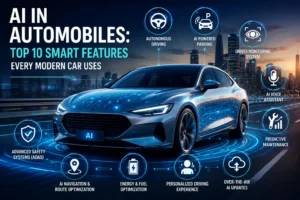
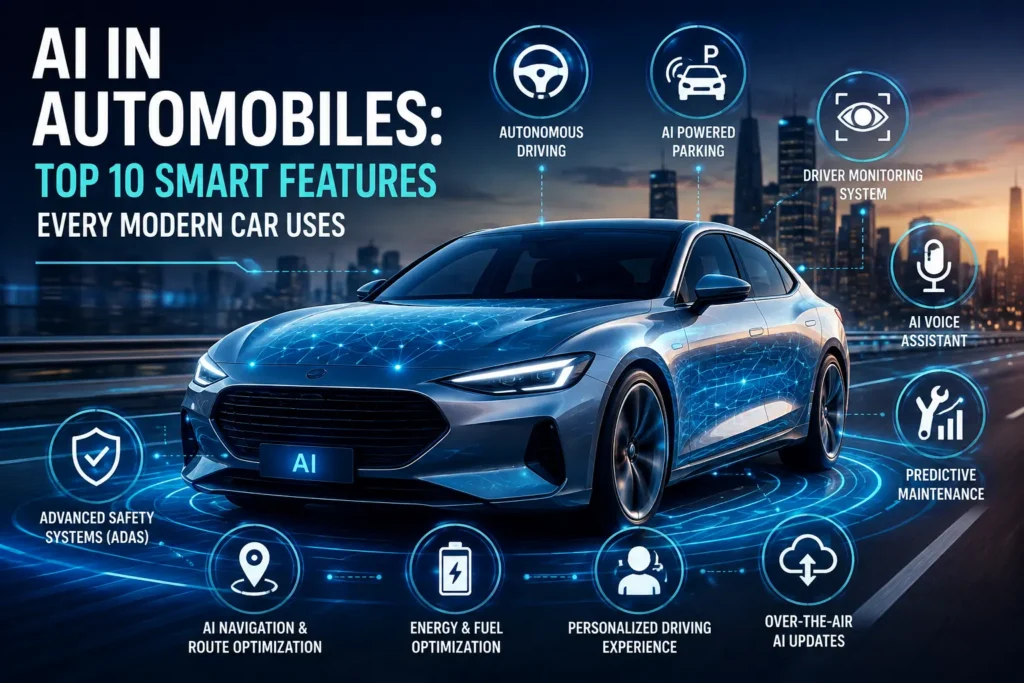
From a luxurious sedan to an electric SUV, even a compact hatchback, AI in Automobiles is likely already at work. The AI is one of the most impactful innovations in today’s vehicles, from accident prevention to understanding your driving patterns and improving fuel efficiency.
Ten years ago, features such as self-parking and voice-controlled navigation were groundbreaking. Nowadays they are being used in many new vehicles. The auto sector is evolving from a traditional vehicle production line toward a continuously learning, adapting and improving intelligent mobility system.
According to market research by Precedence Research , the global market for AI in Automobiles applications is projected to exceed $58 billion. But what does this technological shift actually mean when you turn the key or hit the push-start button?
Let’s break down how AI in Automobiles is quietly driving your vehicle behind the scenes and explore the top 10 smart features powering modern cars today.
Why AI in Automobiles Became the Industry’s Main Character
AI systems are not like software that operates on a certain program; they continually process information, identify patterns, and enhance their decision-making over time.
Your car gathers thousands of data points and records them from the cameras, radar, ultrasonic sensors, GPS, LiDAR (on some models), steering and engine sensors, all the time, every second. All this information is processed by AI in just a few moments, for a safer and more efficient driving experience.
Instead of simply reacting to commands, modern vehicles can:
- Predict potential accidents
- Recognize road signs
- Monitor driver attention
- Optimize battery usage
- Suggest efficient routes
- Learn driver preferences
- Detect mechanical issues before failure
This intelligence is what makes today’s vehicles “smart.”
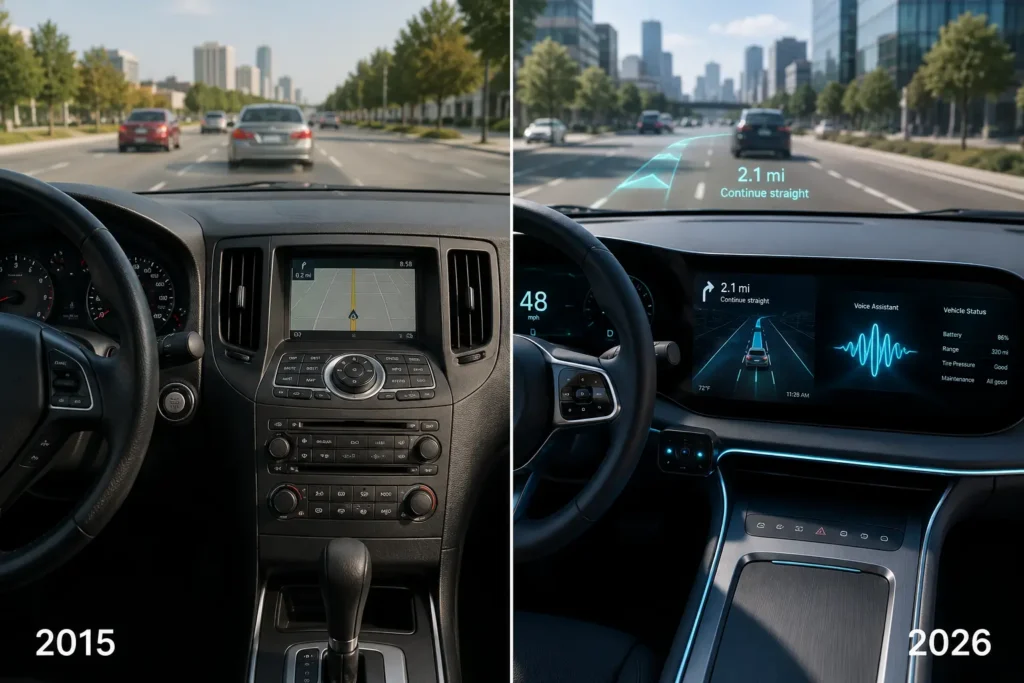
Traditional Cars vs AI-Powered Cars
| Feature | Traditional Cars | AI-Powered Cars |
|---|---|---|
| Driver Assistance | Basic Cruise Control | Adaptive Cruise Control |
| Parking | Manual | Automatic Self-Parking |
| Maintenance | Scheduled Service | Predictive Maintenance |
| Safety | Passive Safety Systems | Real-Time Collision Prevention |
| Navigation | Static GPS | AI Traffic Prediction |
| Fuel Efficiency | Fixed Engine Mapping | Intelligent Optimization |
| Voice Commands | Limited | Natural Language AI Assistants |
Top 10 Smart Features Driven by AI in Automobiles
1. Adaptive Cruise Control (ACC)
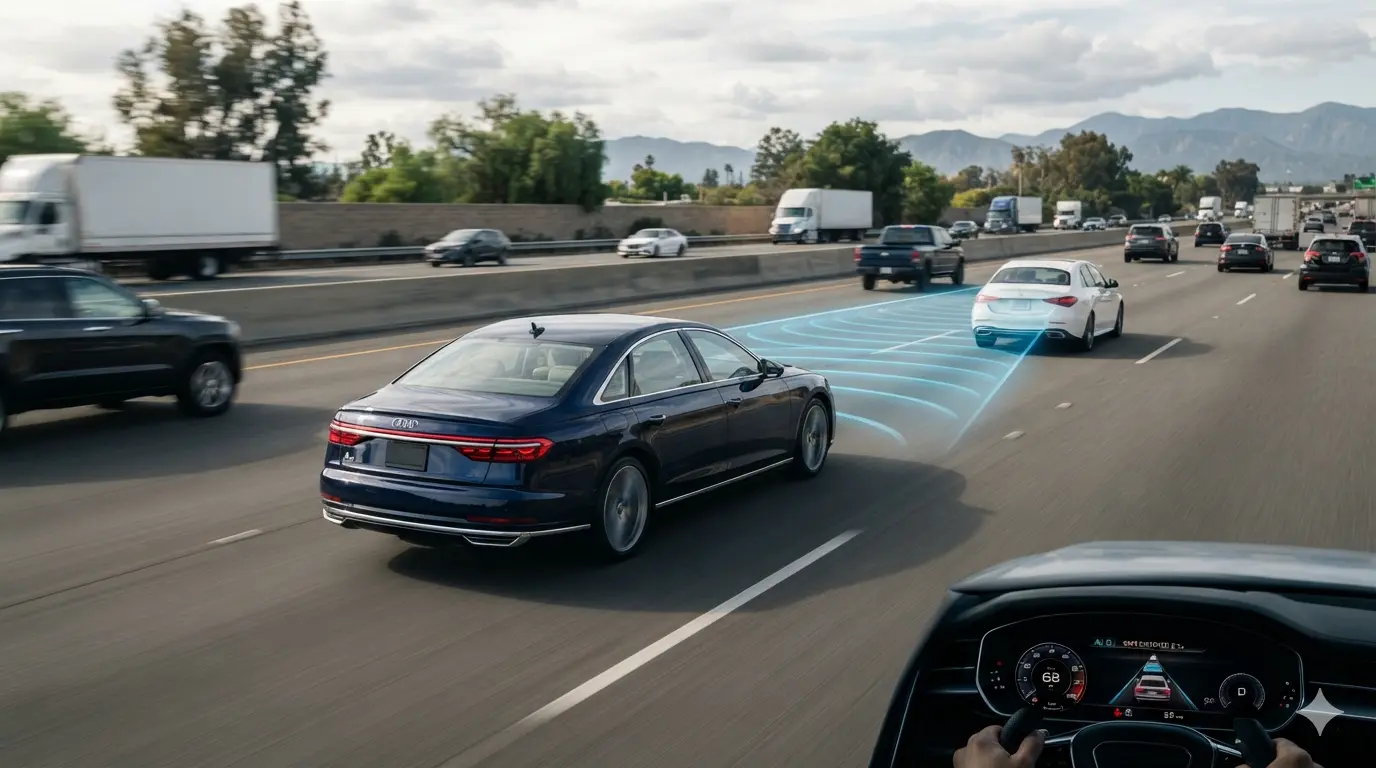
Long trips are no longer a hassle to adjust your speed. Adaptive Cruise Control uses AI to monitor traffic ahead and automatically adjust your vehicle’s speed to maintain a safe following distance.
ACC is not a standard cruise control system, but one that reacts to the actual conditions. In the case of Tesla’s Autopilot and BMW’s Active Cruise Control, the systems integrate radar, cameras, and AI algorithms to enhance the highway experience.
2. Automatic Emergency Braking (AEB)
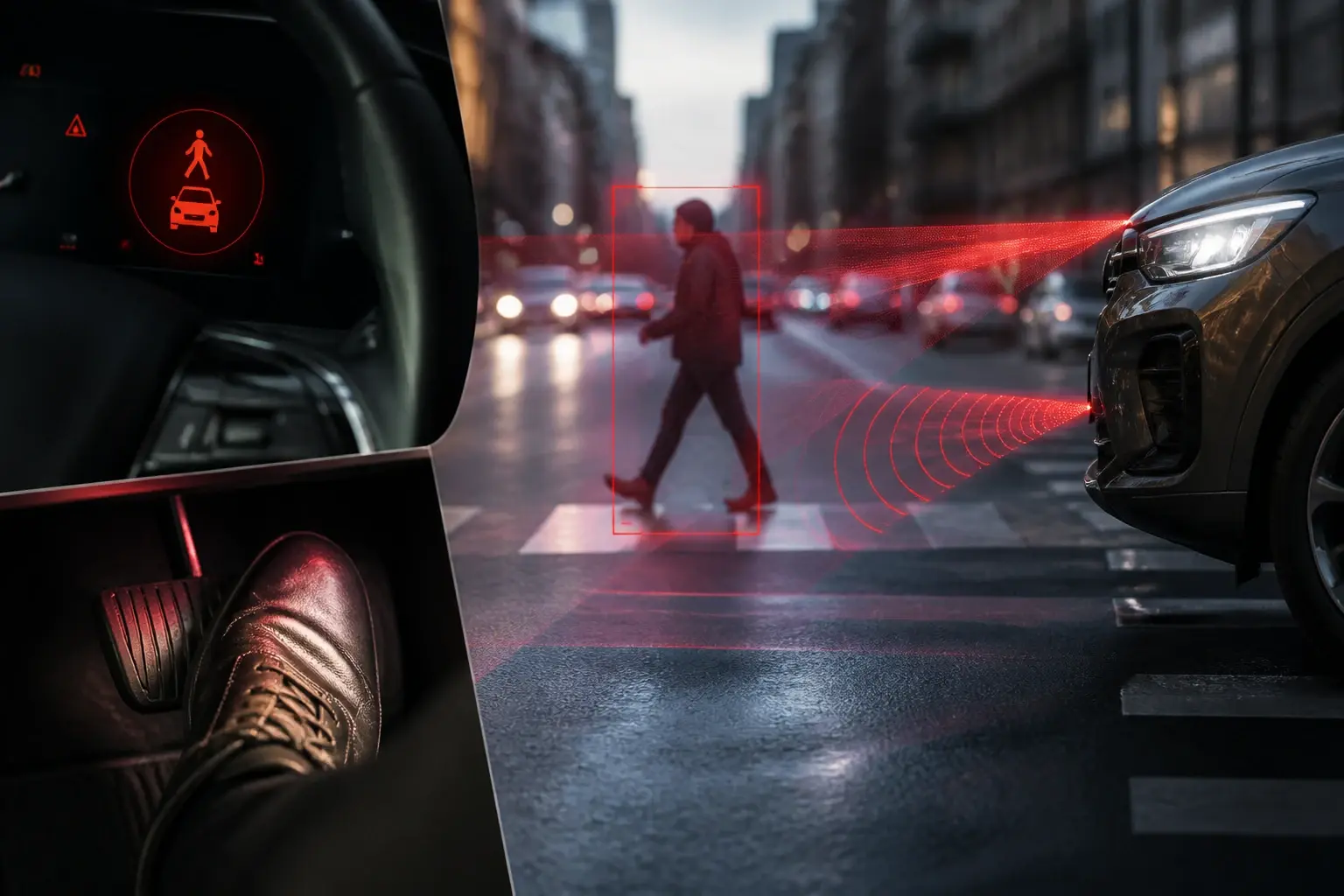
Automatic Emergency Braking is one of the most important safety features, which automatically applies the brakes when there is a danger of a crash.
Research from industry estimates that up to 50% of rear end collisions can be prevented with AEB. Modern systems are able to not only detect cars; they can identify pedestrians, cyclists and even animals and are invaluable in both urban and rural driving.
3. Lane-Keeping Assist and Lane Departure Warning
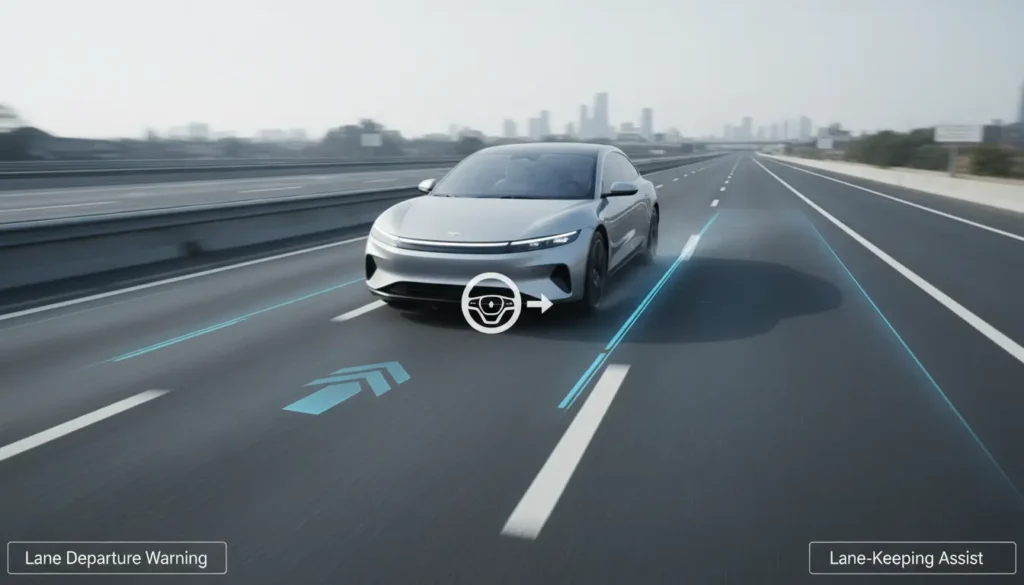
It happens to all of us at one time or another: We lose our concentration on a task and end up being slightly out of our lane. Lane-Keeping Assist employs artificial intelligence camera systems to identify the lane and slowly correct the vehicle’s path if it is detected that the vehicle is drifting away from the lane.
It is a key technology of advanced driver-assistance systems (ADAS), which are already commonplace with brands such as Mercedes, Audi, and Ford, and is now complemented by lane departure warning (LDW), a technology that warns drivers when they drift across the lanes.
4. AI-Powered Voice Assistants
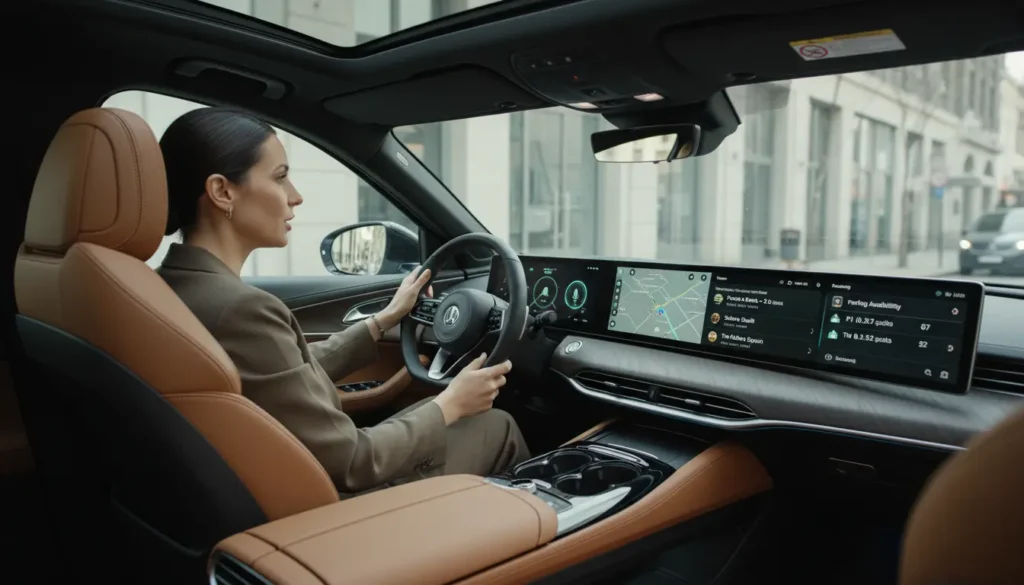
Familiar with the days of having to speak exactly what you wanted to say to get a response? Those days are coming to an end. Today’s AI-powered voice assistants, such as Google’s Gemini, Amazon’s Alexa Plus, and the BMW Intelligent Personal Assistant, can comprehend both natural language and context, as well as answering follow-up queries.
So, for instance, if you say, “I am hungry and I would like something close to me, I would like outdoor seating,” the system can suggest restaurants, give you navigation, even check parking availability – all in one conversation.
5. Smart Navigation with Real-Time Traffic
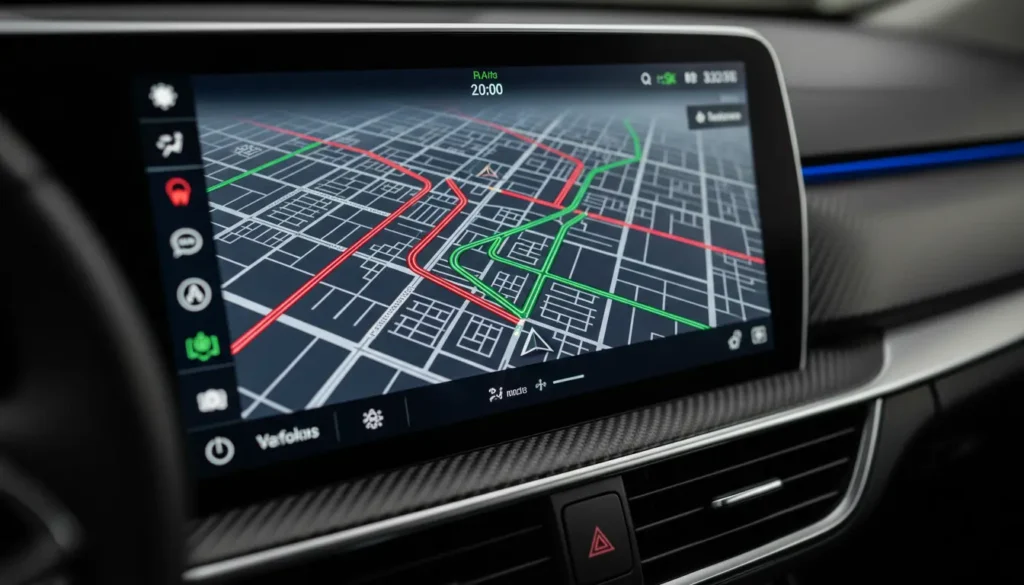
The use of AI navigation systems is more than just a map. They process live traffic data, weather conditions and even past patterns to recommend the optimum, quickest possible routes.
Google Maps’ Live Lane Guidance, rolled out to Polestar and other Google vehicles, is powered by AI to “see” the road and share lane-by-lane directions on the fly. This helps to minimize the number of time vehicles are not out of the way and reduce last minute lane changes which make urban driving less stressful.
6. Driver Monitoring Systems (DMS)
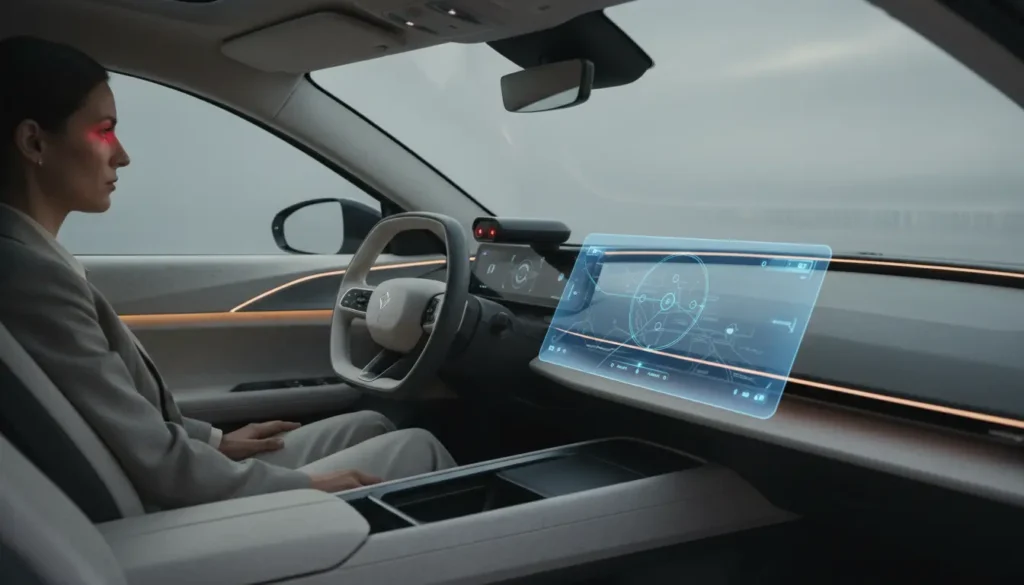
Fatigue and distraction continue to be major contributing factors to car crashes. A Driver Monitoring System powered by artificial intelligence is a system that detects signs of drowsy or distracted driving through the use of an infrared camera, sensors, and measuring heart rate.
If there is a risk, the system can warn the driver, modify the inside lighting or make a recommendation for a stop. Leading companies such as Bosch and Gentex are deploying innovative DMS technology that operates without touching them.
7. Predictive Maintenance
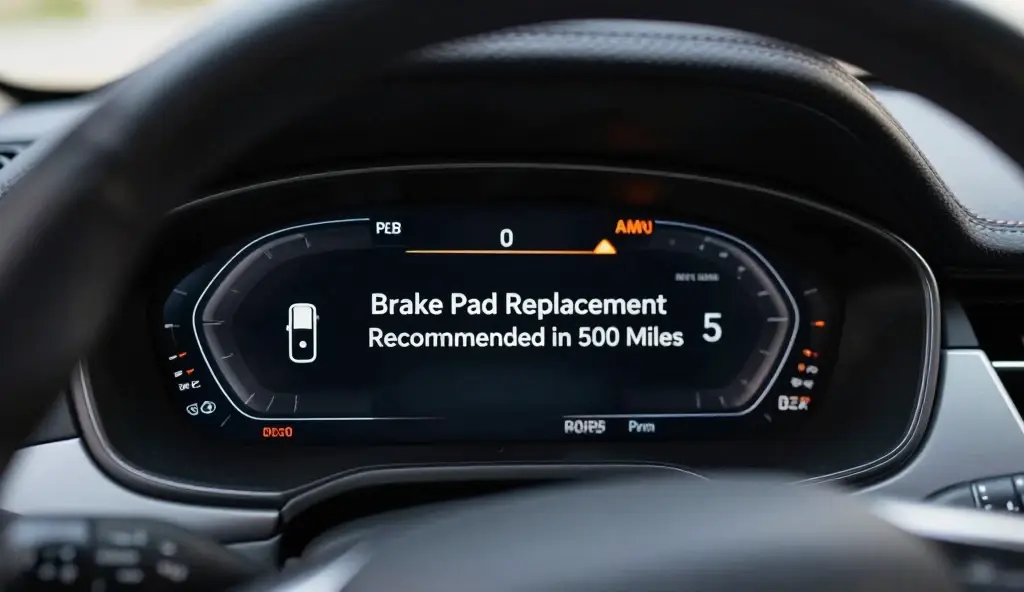
Whereas, a warning light would now have to appear before maintenance is indicated, AI predicts it first. AI models can predict the failure of components such as brakes, batteries, or transmissions by analysing data from on-board sensors.
Some systems are already in use, such as Ford’s and BMW’s predictive maintenance systems, which monitor the health of individual components and warn drivers weeks before a problem occurs. This helps to avoid breakdowns as well as help lower repair costs in the long run.
8. Automated Parking Assist
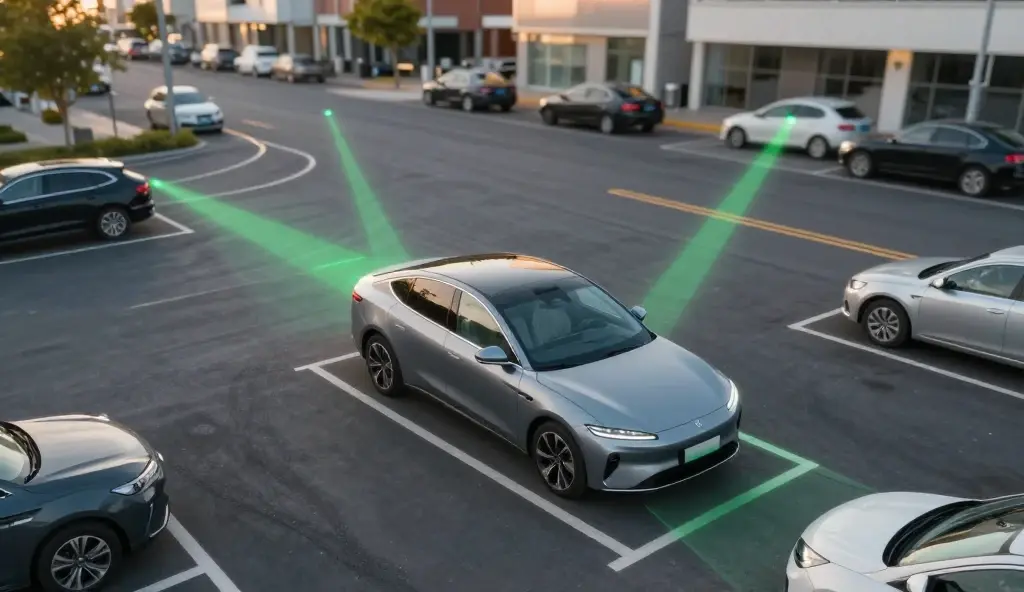
Parallel parking nerve-wracking? Not anymore. The technology behind Auto Parking Assist is a combination of AI, ultrasonic sensors, and 360-degree cameras that detect available parking spots and guide the vehicle into them—sometimes even when the driver is not present in the car.
For example, the Mercedes-Benz S-Class 2026 is equipped with an Intelligent Park Pilot system that can park and unpark the vehicle. The Summon feature at Tesla and Remote Control Parking at BMW have similar functionality, making parking in small urban lots a breeze.
9. Blind Spot Detection with AI Enhancement
The standard blind spot detection system detects cars in the blind spot and notifies the driver. AI-powered versions take prediction one step further, providing real-time collision risk analysis and prediction of near-vehicle movements.
Some systems even integrate with lane-change assist, preventing lane changes when it’s unsafe. This layer of predictive intelligence adds a crucial safety net, especially on busy highways.

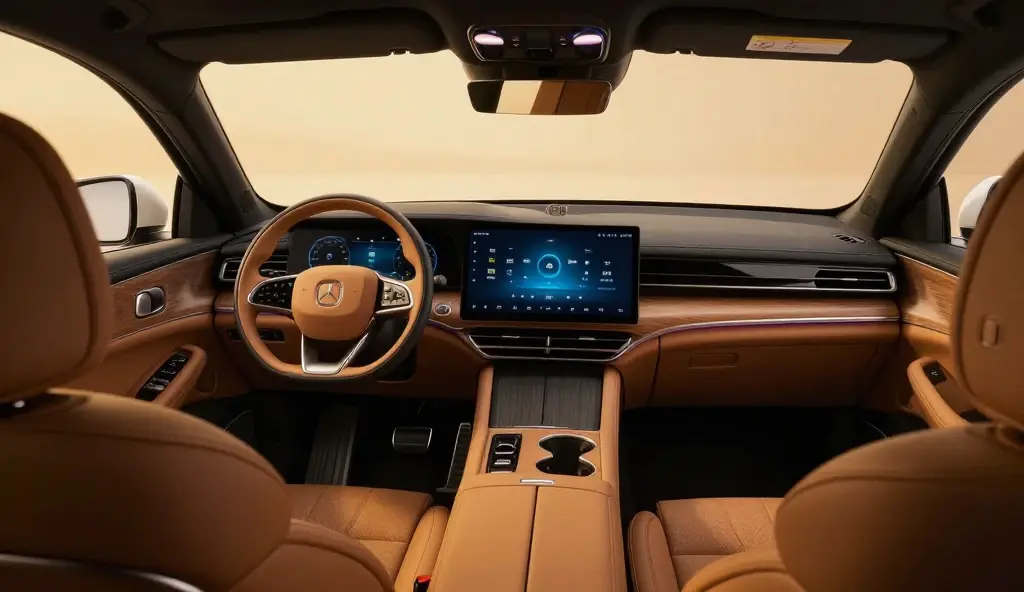
10. Personalized Cabin Experience
Today’s cars are becoming “smart cabins” that adapt and learn from their drivers. AI uses seating, temperature, music, and even driving routes to tailor a special driving experience.
Generative AI is also making its way into luxury brands, such as Lucid and Mercedes, which are implementing features that allow drivers to interact with the car through conversational interactions, like using natural language to adjust the settings or ask questions, even to control entertainment systems.
What Does the Future of AI in Automobiles Look Like?
In the next generation of automotive AI, it’s likely that it will be more about connected intelligence than individual features.
The computer system of a vehicle is gradually evolving from three distinct subsystems (navigation, safety, infotainment) to the centralized system that allows different systems to communicate. This shift is part of the roadmap toward software-defined vehicles, which are aimed at advanced connectivity, over-the-air updates and AI-powered features, says McKinsey.
Suppose you have a car that knows that:
- There is a lot of traffic, more than usual.
- Driver is getting fatigued.
- Battery drain is going up.
- A charging station is coming up.
- Rains making it difficult to see.
These are five totally separate problems, but they could all be combined into a single problem, and the vehicle behavior could adapt to the combined result.
However, the true power of AI in Automobiles is in this.
Not only smarter individual features, but smarter decisions made by aggregating lots of information.