

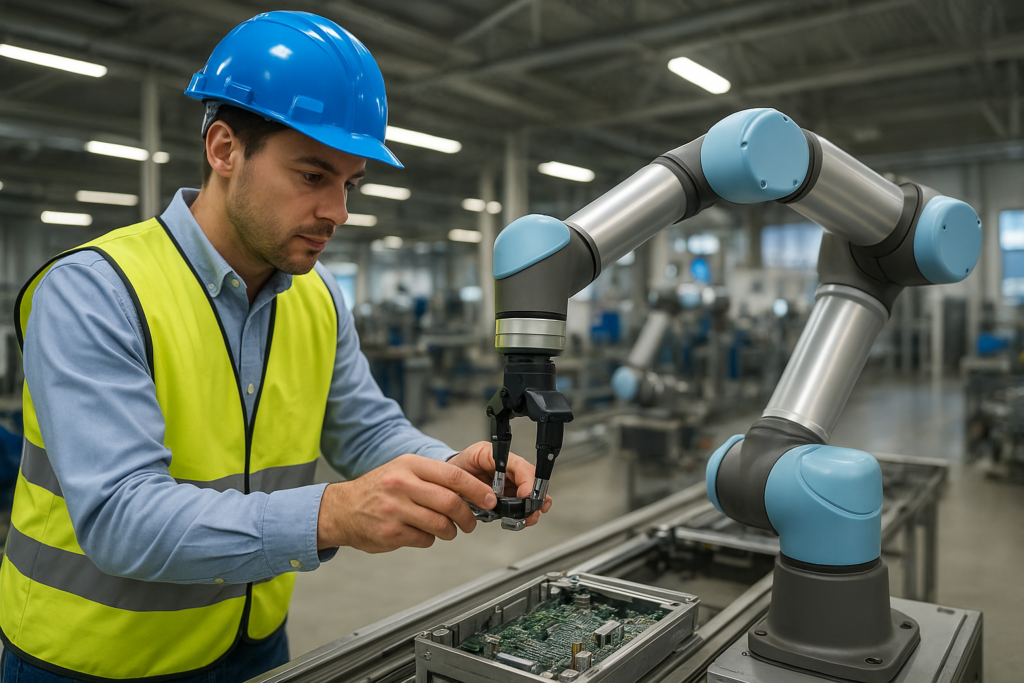
Imagine arriving at work and sharing your workspace with a robot that hands you the part you need. It aligns itself beside you to do the heavy lifting and stops safely when you step into its path. That scenario is not just a vision of the future. With the rise of collaborative robots (cobots), workplaces in 2025 are beginning to resemble teams of humans and robots working side by side, rather than robots hidden behind fences.
In this blog, I’ll guide you on how cobots are changing modern workplaces. I’ll discuss what’s driving the shift and what’s holding it back. You’ll also learn how you, as a business leader or design professional, can start thinking differently about automation.
Collaborative Robots (cobots) are the Next Step Beyond Traditional Robots
To understand what makes Collaborative Robots(cobots) special in 2025, it’s helpful to contrast them with “traditional” industrial robots.
Traditional Industrial Robots
- These are large and often fixed in place. They work separately from humans because of safety zones or cages.
- They are programmed for specific, repetitive tasks. For example, they can spot-weld the same point thousands of times.
- They offer less flexibility. Changing the task often requires significant re-engineering.
- They can handle heavy loads or operate at high speeds, but they come with high costs and require extensive infrastructure, including safety systems and guards.
Collaborative Robots (Cobots)
- These robots are designed to work alongside humans in the same physical space.
- They are easier to deploy since many offer “plug-and-play” features, simple programming, and lighter safety requirements.
- They are more flexible and can be reconfigured easily. They work well for smaller batches, changing tasks, and adapting workflows.
- Typical trade-offs include a lower payload and slower speeds compared to heavy industrial robots. However, the advantage lies in their agility and ability to collaborate with humans.

Key Insights into the Rise of Cobots in 2025
Rapid Market Growth
- The global market for collaborative robots is expected to grow significantly. For instance, one forecast puts it from US$1.42 billion in 2025 to US$3.38 billion by 2030 (CAGR ~18.9 %).
- Another analysis suggests shipment growth of ~20.6 % in 2025-26 as the market rebounds with new applications.
- In North America alone, in Q1 2025, cobots accounted for 11.6 % of all robot orders.
Broadening Applications & Industries
Collaborative Robots (cobots) are no longer just for assembling car parts in big factories. In 2025 they’re branching into:
- Logistics & warehousing: for picking, packing, sorting.
- Healthcare / pharmaceuticals: for lab automation, precision tasks, even assistive roles.
- Manufacturing (especially electronics, battery, EV lines): tasks like screwing, inspection, handling sensitive parts.
- Food & beverage: packaging lines with variability, hygiene concerns, flexible tasks.
The Real Workplaces of 2025: Fresh Perspectives & Challenges
Let’s explore how Collaborative Robots (cobots) are reshaping modern workplaces—and what challenges still stand in the way.
Real-World Workplace Impacts
- Flexibility Wins: Cobots enable teams to go from multiple assembly operations in a high-mix, low-volume environment, such as electronics or medical devices, in hours instead of days.
- Better Ergonomics: Cobots are designed to perform repetitive or heavy work, alleviating worker fatigue while improving health and safety on the production floor.
- Resilience and Adaptability: With ongoing supply chain pressures, Collaborative Robots allow manufacturers to remain nimble as they are simple to reprogram and redeploy.
- Access for SMEs: Once limited to large-scale manufacturers, cobots are now affordable and user friendly enough for small-and medium-sized businesses.
b) Key Challenges to Overcome
- Acceptance from Humans: Workers may be hesitant to accept automation because they may believe they will be replaced. Framing cobots as colleagues that complement their work instead of replacing it will help build trust among workers.
- Integration Issues: While cobots are flexible work systems, you will need to update infrastructure, conduct safety assessments, and design workflows.
- ROI and task selection: Not all processes will be suitable to automated work, so cobot based work should choose tasks that are measures of productivity or have measurable ergonomic benefits
- Technology limitations: Collaborative robots are improving, however they are still not of a similar speed and payload to heavy work industrial robots.
4 Strategic Insights for 2025 and Beyond
Here are 4 focused strategies to make the most of Collaborative Robots (cobots) in your workplace.
- Enhance, Don’t Replace: Consider cobots as allies to support and complement a human’s work. Machines offer certainty and repetition, and humans add creativity and problem-solving skills. Together, they can accomplish more.
- Focus on the Smart Pilot Tasks: The tasks should be repetitive, ergonomically difficult, and with low complexity. This will make it easier for Collaborative Robots to demonstrate their value.
- The Human Aspect: Train employees to work with cobots, get them onboard as early as you can, and explain the reason—reduce work effort vs. jobs.
- Build Flexible Automation: Use modular cobots with interchangeable tools and mobile configurations. Think of cobots as human teammates, rather than assets.
Looking Ahead: What’s Next for Collaborative Robots (cobots) Beyond 2025
As we progress further into the decade, some key trends appear ready to take cobots to the next level:
- Mobile cobots and hybrid platforms: Integrating cobot arms on mobile bases for autonomous navigation, repositioning, and collaboration in different zones.
- AI and vision: Cobots utilizing vision, machine learning and “lead through” programming to reactively adapt to dynamic tasks.
- High payload cobots: Cobots have historically been limited in payload; new active cobot models are breaking that barrier thus enabling more tasks to be automated.
- Service models and democratization: “Cobot as a service” models decrease upfront costs, thus allowing SMEs to pilot and scale cobots more easily.
More applications and wider than manufacturing: Healthcare, ag, logistics, , e.g. have all like potential to grow cobots on account of the need for flexible, safe automation.
Conclusion
In 2025, Collaborative Robots (cobots) are no longer the weird gadgets – they are a fundamental automation asset across industries. For organizations that can reimagine how they work, collaborative robots provide a powerful way to improve productivity and the human side of work. The relevant question is not, “How many robots can we deploy?” but, “How can humans and robots work together?”