Introduction
Can you think of opening your phone in the morning to find sales notifications in your inbox? No packing of shipping boxes, no running stock, and no long lines in the call center. This is not a dream come true for the modern digital economy—it’s what it’s all about: selling digital products.
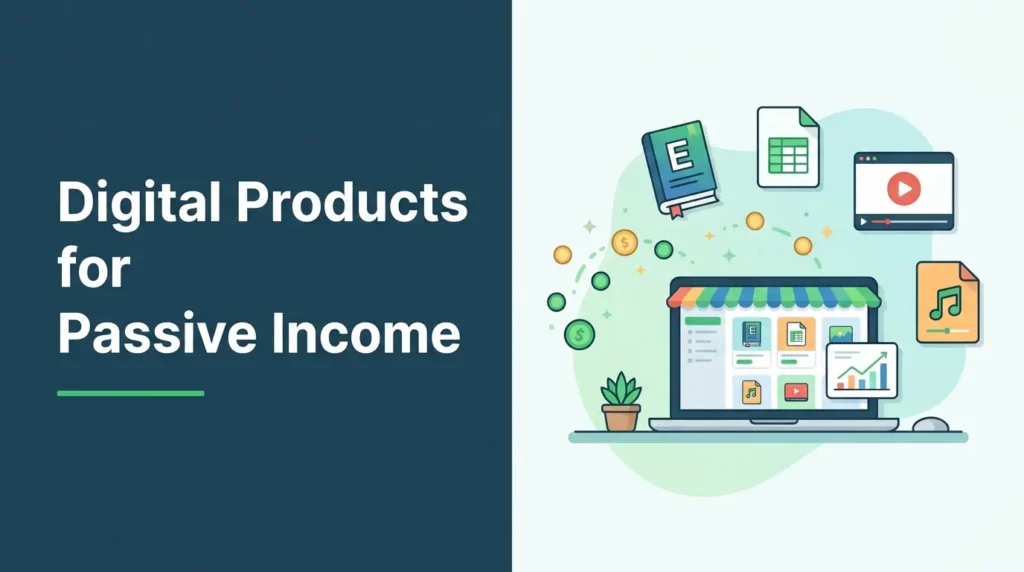
A digital product is a product that you sell online and the customer receives it electronically, so you don’t need to ship it. Such products can be sold either as a downloaded file or as a streamed file. Templates, ebooks, or courses can make sales at 3 am, even while you sleep. The pitch skips the hard work: choosing a product people want, creating it, reaching customers, and keeping it relevant.
This guide will explain what a digital product is, what “passive income” with digital products can look like, how much effort it requires to build one, the amount you can reasonably expect to earn, and how to build yours so it requires as little effort as possible.
What Are Some Examples of Digital Products?
If you’re looking to sell digital products online, this list is a great place to start:
- Documents: ebooks, guides, printables, planners and worksheets
- Templates: Notion, Canva, spreadsheet and resume templates
- Courses and training: video lessons, workshops and memberships
- Creative assets: digital art, fonts, presets, stock photos and music
- Software: apps, plugins and small online tools

Unlike a physical product, you don’t have to have inventory or shipping, and with a digital product, every additional copy will cost you virtually nothing. That’s why they’re frequently associated with earning money while you sleep.
What Does “Passive Income” Actually Mean?
True passive income refers to the income that arrives with no ongoing effort. Selling digital products is better described as front-loaded income. You do most of the work at the start (creating, listing and promoting), and then the effort drops sharply.
| Factor | Freelancing | Digital Products |
| Main effort | Work on individual client projects | Create and market products |
| How you earn | Usually by the hour or project | Usually per sale, subscription, or license |
| Repeat sales | Often require more client work | One product can sell repeatedly |
| Time flexibility | Depends on deadlines and clients | More flexible after setup |
| Ongoing work | Client delivery and communication | Marketing, maintenance, and support |
| Main challenge | Finding clients and managing time | Finding demand and attracting buyers |
Neither model is automatically better. But if you already have something to sell, freelancing can bring in cash faster, and digital products can provide you with a way to sell the same work over and over.
Can You Really Earn While You Sleep?
The short answer is yes, absolutely—but with an important asterisk. In fact, these products have advantages such as:
- Zero Inventory & Shipping Costs: – Selling 1 copy or 10,000 copies comes with virtually the same cost once the software is created.
- 24/7 Automated Sales: Platforms such as Gumroad, Shopify, Lemon Squeezy, or Teachable offer automated sales and checkout, payment processing, and automatic file delivery and work around the clock—the details are not affected by the buyer’s time zone.
- High Profit Margins: Digital products typically achieve 80–90% profit margins because there are no manufacturing, shipping, or storage costs eating into your revenue.” — ThriveCart

How Artificial Intelligence (AI) Is Revolutionizing Digital Product Creation
If creating digital products used to take months of hard labor, AI has completely rewritten the rulebook. Today, creators use AI to launch products in days instead of months.
Here is how AI tools accelerate every step of the process:
| Stage | How AI Speeds It Up | Recommended Tools |
| Brainstorming & Research | Analyze niche trends, find audience pain points, and structure product outlines. | ChatGPT, Claude, Gemini, AI-generated images |
| Content Creation | Draft e-books, generate course scripts, or write documentation in minutes. | ChatGPT, Jasper, Notion AI |
| Design & Visuals | Create cover art with DALL-E in ChatGPT, graphics, UI kits, and stock imagery automatically. | Midjourney, Canva AI |
| Coding & Apps | Build mini-SaaS products, web apps, or Chrome extensions even without a computer science degree. | GitHub Copilot, Cursor AI, v0.dev |
| Marketing & Copywriting | Generate high-converting sales page copy, email sequences, and social promo posts. | Copy.ai, ChatGPT |
4 Steps to Sell Your First Digital Product Online
If you’re ready to start building your passive income stream, follow this simple roadmap:
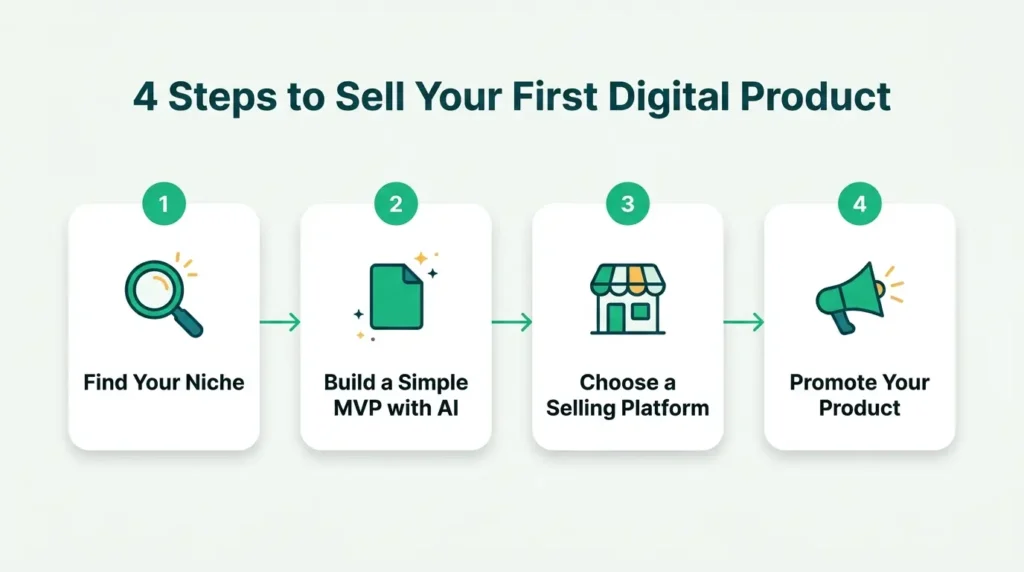
1. Find Your Niche:
Find the problem that could be your niche. Identify the sweet zone where your skills and interests meet market demand and the capabilities of AI tools. What questions do people constantly ask you? What workflows have you mastered?
2. Leverage AI to Build a Minimum Viable Product (MVP)
Don’t spend 6 months making your first product. Create a quick, high-value asset with Generative AI, like a 20-page tactical e-book, 10 customized free AI tools or prompts, and a Notion dashboard.
3. Choose a Platform to Sell Digital Products Online
Submit your digital creations to a creator site, such as Gumroad, Lemon Squeezy, Etsy or Shopify. These platforms will automatically accept payment through Credit Card/PayPal, and send the buyer their download link immediately.
4. Promote Your Product
Ensure that potential customers consistently see your product page through search engine optimization (SEO), automated social media scheduling, or targeted email newsletters. Read further on Make Google ads work for your business; a complete guide. Passive income is often seen as something that requires once-and-for-all creation, then you can just walk away. Actually, you’re not taking work away—you’re passing it on to software.
The Modern Creator Tech Stack: How to Automate Your Business
Your automated tech stack should be able to manage three key pillars without manual effort to earn while you sleep:
- The Automated Checkout & Instant Delivery Layer: Platforms like Lemon Squeezy, Gumroad, or Shopify don’t just process payments; they act as your digital fulfillment department. Even at 3:14 AM, the second the transaction clears, the system encrypts a safe download link and emails it to the customer, records the sale for tax purposes, and updates your inventory database (even if you don’t have the stock in the first place).
- Customer Self-Service & Documentation: If a buyer asks you how to use your Notion template or install your plugin, it will be a blow to your passive marketing. Successful creators build a simple Notion FAQ page or a 3-minute Loom video tutorial embedded directly into the receipt email. This reduces the number of support requests. For example, a pharmaceutical web self-service portal with FAQs was associated with about a 20% drop in medical information requests (Helmich, M. L. (2017). Reducing call volume at medical information centers by switching to a web-based self-service facility—what to consider? Providing customers with digital medical information on the internet. Therapeutic Innovation & Regulatory Science, 51(3), 327-331.)
- Automated Traffic Flywheels: True passive income depends on content flywheels, and they include an SEO-optimized blog, a library of tutorials on YouTube, or a library of automated pins on Pinterest, which are attracting all the right search traffic, 24/7.
Where Will Your Digital Product Customers Come From?

Just because you build it, they will not come. This is the most difficult reality that a digital product maker ever has to come to terms with. On the other hand, marketplaces such as Amazon have an inbuilt buyer intent if you are selling physical products. As a self-publishing entity you are facing millions of free products on Google, YouTube, GitHub and more. To get a great product to sell without any sales, you need to know your acquisition channel
Marketplace Leverage
Marketplaces such as Etsy, Creative Market, and Udemy provide built-in traffic, but sellers sacrifice margin and customer ownership. Etsy charges listing, transaction, and payment-processing fees (Etsy Help Center); Creative Market pays sellers 50% of net revenue (Creative Market Shop Terms); and Udemy retains 63% of marketplace-driven course sales (Udemy Instructor Terms).
How Much Does Etsy Take From a Sale?
Etsy typically charges a listing fee, a transaction fee and a payment-processing fee on each sale. The exact amounts depend on your country and change from time to time, so check Etsy’s official fees page before you price your product. Compare what’s left after fees with what you would keep selling directly.
Selling directly through Shopify or Lemon Squeezy allows creators to keep the majority of each sale—often over 90% after standard payment fees—and own their customer email list (Shopify Pricing; Lemon Squeezy Pricing; Shopify Email List Guide). However, unlike marketplaces, you are responsible for generating your own traffic through organic content, paid advertising, or your existing audience (Shopify Marketing).
How Much Money Can You Make Selling Digital Products?
A definitive income number doesn’t exist for all digital-product marketers. Profit depends on the demand, the price, the quality of the product, traffic and how to get the traffic to the potential customer.
Suppose that you have one template with the price of $12:
- 10 sales per month: $120 in gross revenue.
- 50 sales per month: $600 in gross revenue.
- 100 sales per month: $1,200 in gross revenue.
Can You Make $10,000 a Month Selling Digital Products?
It’s possible, but it isn’t typical, and it usually takes time, a strong product and steady traffic. With a $12 template, you would need roughly 834 sales a month to reach $10,000 in gross revenue. With a $50 product, you would need about 200. Most sellers start much smaller, so treat large income figures as goals, not promises.
Best Digital Products to Sell for Passive Income
If you’re looking for digital product ideas that need little upkeep, these are a good place to start. Passive sales are the kind of sales that can be made by virtually any digital product, but some need much less work once they have been released than others. The best low-effort products have a low refund rate and require no customer onboarding or technical updates.

What Is the Easiest Digital Product to Create?
For most beginners, printables, simple templates and short guides are the easiest to create. They take little time to build, they’re cheap to test, and they don’t need technical updates. Start with one small product that solves one clear problem.
Notion and spreadsheet templates: They require the least maintenance. Productivity templates and automatic finance trackers require few updates after creation, unless software APIs change. They are used straight away by buyers, so support tickets are rare.
AI Prompt Bundles & Workflow Blueprints: Prompt or Zapier/Make automation blueprints are in high demand as industries rush to adopt workflow automation. They are in high demand and solve business problems immediately.
Aesthetic and design assets: Canva templates, Lightroom presets, vector icons and digital fonts. These are unlikely to break. Once uploaded to any marketplace, they can be sold passively for years.
Micro-e-books and specialised guides: Static text documents are not subject to technical depreciation. However, they may need to be updated once a year if your niche changes rapidly (such as tech or AI tutorials).
Tips for Publishing on Your Website
Internal linking: Provide a link to your other blog posts about AI tools (for example, “Top 5 AI Writing Tools in 2026”).
Visuals: Include visual aids such as infographics or mockups of digital product downloads (e.g., a 3D book cover or a SaaS dashboard preview).
Call to Action (CTA): Think about adding a free checklist or guide at the end that people can download. This will help you to build your newsletter list!
Red Flags: How to Spot Bogus Claims About Passive Income
Keep an eye out for anyone who presents digital products as a sure-fire way to make money fast.
Your 30-Day Action Plan
- Days 1–5: Research your idea. Choose a target audience, examine competing products, and identify a problem your product could solve.
- Days 6–15: Create your first product. Develop a simple, useful version. Focus on solving one problem well instead of adding unnecessary features.
- Days 16–20: Prepare your listing. Write a clear title and description, create preview images, set your price, and test the purchasing and delivery process.
- Days 21–30: Promote and evaluate. Share relevant content through one or two channels. Review visitor engagement, questions, sales, and feedback, then decide what to improve.
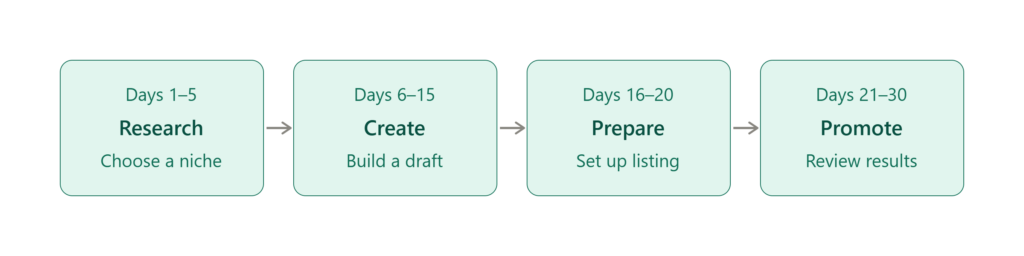
At the end of the month, you will have practical information about your idea and your audience. You may have made a sale, or you may have discovered that your product or marketing needs adjustment. Neither outcome guarantees future success, but both can inform your next decision.
Frequently Asked Questions
Is it possible to make money while you sleep by selling digital products?
Yes. The purchase and delivery of digital products can be done automatically at any time, including while you sleep. Nevertheless, it is usually necessary to invest a considerable amount of time in creating, marketing and maintaining them first.
Can digital products genuinely serve as a reliable source of passive income?
Not entirely. They are better described as low-maintenance, front-loaded income. Over time, you still need to market, update and support your products.
How long does it take to make your first sale?
It varies. An early sale can be achieved within days by some sellers, especially on busy marketplaces, while several months can be needed by others to build traffic and trust. The timeline is affected by quality, niche and promotion.
What is the potential revenue from digital products?
There is no fixed number. Results ranging from nothing to a meaningful side income are achieved, depending on product quality, demand, traffic and consistency. Be cautious of anyone who makes a promise regarding a specific amount.
Do I need an audience before I start?
Not necessarily. Marketplaces such as Etsy can attract buyers even if you don’t have your own following. However, building an email list or establishing a content presence over time will make your income far more stable.
Is Etsy still worth it for digital products in 2026?
It can be, especially if you don’t have an audience yet, because Etsy gives you built-in traffic. The trade-offs are fees, strong competition and less ownership of your customer list. Many sellers start on Etsy to test an idea, then build their own store and email list over time.
Final Thoughts: The Honest Truth About Earning While You Sleep
Digital products can help you build a business. This business can earn revenue without requiring your active involvement in every sale. However, this depends on creating something useful, reaching the right audience and improving your approach over time. The starting point should be one product, one audience, and one or two marketing channels. Test your idea, learn from the results you achieve, and avoid treating claims about online income as guarantees.
💬 What’s Your Next Big Idea?
Are you planning to launch an e-book, a SaaS tool, or a template library? What AI tools are you using to build it? Let us know in the comments below!
Disclaimer: This article is for general information only and does not guarantee income. Check current platform fees, policies, and local tax and legal requirements before you sell.